
Four answers on the Belgian border
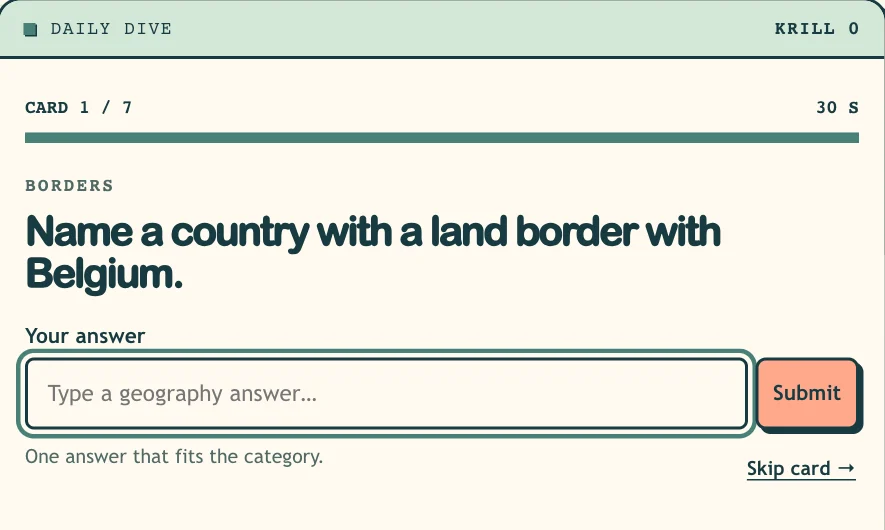
Imagine the first card asks for a country that shares a land border with Belgium. France is a perfectly good answer. Germany works too. If you can picture the short stretch southeast of the Belgian Ardennes, you might remember Luxembourg. Each name answers exactly the same question, yet the three players who type them come away with different scores. That choice is the heart of Geography Krillion. You only get to bank one place per card.
On this particular answer sheet, France earns 10 krill, Germany earns 25, the Netherlands earns 75 and Luxembourg earns 100. Think of it as a little journey around Belgium. Start near Lille and cross the French border. Head north towards Antwerp and the next country on your route is the Netherlands. Travel east through the German-speaking part of Belgium and you reach Germany. Farther south, a train from Arlon can carry you into Luxembourg. Four quite different journeys give you four ways to solve the clue.
Those point values belong to this card. A country with a short border can be easy to remember, and a large country can be a surprising answer to a different question. The game assigns the values in advance. You can play early in the morning or just before the UTC date changes and earn exactly what another player earned for the same answer.
What the seven cards ask you to name
Borders. Picture a pencil tracing the outline of a country. Every time the name on the other side of the pencil changes, you have another possible answer. Watch for the word “land.” A ferry from one country to another proves you can travel between them, but it tells you very little about whether they share a land boundary.
Capitals. A card can offer several countries and ask for the capital of any one of them. Start with the country whose capital you can name with confidence. Then glance at the others. On a card about Argentina, Uruguay and Paraguay, Buenos Aires is a safe choice. Across the Río de la Plata lies Montevideo. Farther inland, Asunción gives you a third option. Type just the city you want to submit.
Fresh water. Rivers and lakes need different kinds of mental maps. A river gives you a line to follow through a city or beneath a bridge. A lake gives you a shoreline that several countries may share. If the question asks who has a shore on Lake Victoria, writing “Victoria” repeats information you already have. You need the name of a country on that shore.
Islands. Ask yourself whether the clue wants a piece of land or a political boundary. Japan is the country that includes Hokkaido. Hokkaido is one of the four large islands that make up most of Japan. In the Caribbean, Hispaniola is one island with two countries. Haiti fits a question asking for one of those countries. Hispaniola fits a question asking for the island they share.
Landmarks. Match the scale of your answer to the question. Petra is an archaeological site. Jordan is its country. Both could appear in the same atlas entry, so check what the card gives you and what it wants back. City questions work the same way. The Eiffel Tower almost hands you Paris, but only the wording of the question tells you whether to submit Paris or France.
Regions. Here a capital can point to something smaller than a country. Austin identifies Texas on a state card. Toronto identifies Ontario on a province card. A clue about Canada's three territories asks for a different set again. The small label above the question is a useful first hint, but the line underneath it tells you exactly which kind of region to name.
Coasts and seas. Imagine standing on the shore and looking across the water. Sometimes the question wants the water you can see. Sometimes it wants the country where you would land. Dover and the French coast make a memorable picture for either kind of clue. Read the first few words once more before you let your fingers finish the answer.
Playing today's round
Choose Start today's dive when you are ready. The welcome guide lets you look at a sample question and the scoring tiers before the first clock begins. Once a question opens, you have 30 seconds. Type a single name and press Enter or use Submit. A name the sheet recognises takes you straight to the recap. An unrecognised entry leaves the card open, so you can correct your spelling or try a different place with the time you have left.
There is no benefit to typing a list of candidates. If your first thought is “Peru or Bolivia,” decide which name you want and enter that one. The first accepted answer closes the question. You cannot exchange it for a rarer answer after you see the points. A small accent mark is less important than getting the place right. The checker can recognise Asuncion without the accent, for instance. It also accepts a number of common alternative names.
If a question draws a blank, Skip card reveals an example from the sheet. Running out of time also closes the card. Both outcomes earn zero, and the recap waits for you. Take a moment to work out where the example belongs. Then choose Next card to start the next timer. A rough opening has no effect on which six questions you see afterward.
Reading the catch on your scorecard
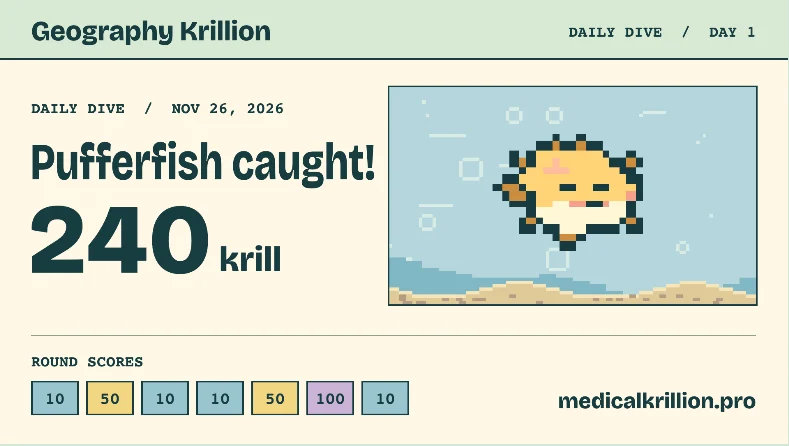
Seven cards make one daily total. The first catch is a Shrimp at 30 krill. A Crab takes 80, a Pufferfish takes 160, an Octopus takes 250 and a Whale takes 340. Suppose your first two cards yield 75 and 10. You have 85 krill and enough for a Crab. Another 75 would take you to exactly 160. If you miss that third card, the 85 you already earned stays in the total.
At the end, open the card review to see where your points came from. Two people with the same catch may have played very different rounds. One might have collected a few points on almost every question, while the other found an unusual island and missed several capitals. To compare without giving away today's places, share the result card first. Save the conversation about which island you picked until both of you have finished.
A daily game you can play together
The daily set follows the UTC date. Someone opening it in another time zone gets the same seven cards as long as you are both on the same UTC day. Check the countdown on the start panel if you are arranging a game across midnight. With local browser storage available, returning to the same browser lets you pick up your daily progress. A friend's phone has its own round and its own score.
After the day ends, use the Geography Krillion Archive to look for its dated replay. The calendar is handy when a friend remembers the question about a bridge but cannot remember the city they named. If you simply want a fresh question now, Geography Krillion Unlimited shuffles the deck and lets you decide when to finish. Your result for today's shared set stays available on the daily page.
Daily geography questions
Can I play Geography Krillion free online?
Yes. Open the daily round in your browser and choose Start today’s dive. There is no sign-up and no download. You can read the welcome guide before you start the clock.
Can a second guess add points to the same card?
The first accepted place closes that card. If the answer field is still open after a rejected guess, you can enter another name before the clock reaches zero.
Where can I find yesterday’s questions?
Open the geography archive and select the date on the calendar. Each scheduled replay opens after its original UTC day ends, and has its own score.


