
A geography game for a spare minute or a long train ride
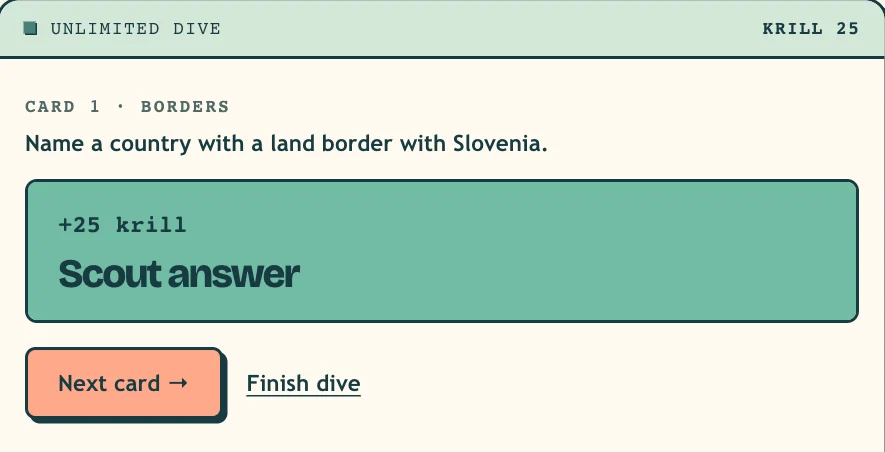
In Geography Krillion Unlimited, you have 30 seconds to name a place that fits the opening clue. You might be looking for the country on the other side of a border, a capital city, or the island beneath a familiar town. Submit one place. The recap shows what it earned and leaves you with a choice. Next card deals again. Finish dive closes the run and gives you a scorecard. You can make that decision after one answer or carry on well beyond seven.
A short run is enough to settle an argument with yourself. Do you actually remember which island Palermo stands on, or do you just recognise the city name? A longer run has a different rhythm. An answer about Sicily might be followed by a bridge in Prague, a Canadian province or a sea on the edge of Europe. The deck shuffles at the start and deals through its cards before it shuffles again. There is no need to wait for a new calendar date to try another run.
A three-card warm-up for Geography Krillion Unlimited
For the first card, concentrate on answering in the right unit. Consider a question about the national capitals of Egypt, Kenya and Ghana. Choose one of those countries and say the city's name to yourself. If Cairo comes immediately to mind, you already have a valid choice. If Nairobi is the city you know best, submit that. If you remember Accra from a photograph or a family trip, that memory has just given you a third way into the same question.
For the second card, give yourself a few extra seconds to look past the familiar name. Suppose you are asked which country includes Easter Island, Kangaroo Island or Vancouver Island. Canada may be the first name to surface. Before you type it, picture the other two. Kangaroo Island sits off South Australia. Easter Island is far out in the Pacific and belongs to Chile. The clue allows any one of those countries. It pays to think of alternatives while you still have time to enter one.
For the third card, practise reading the recap. On a miss or a skip, the sheet offers an example. Work out which part of the clue makes the example fit. If the example is France on a question about the Bay of Biscay, picture the curve of the Atlantic coast below Brittany and follow it south to Spain. Now you have a way to remember two answers. You can stop here with Finish dive even if the third question earned nothing.
Ways to find a second answer
Start with the crossing. Pick a journey with a clear start and end. A train through the Channel Tunnel takes you from the United Kingdom to France. A trip across the Strait of Gibraltar takes you between the European and African sides. Frontiers become easier to remember when you can picture the landscape changing beneath the journey. Do check whether the question asks about a strait or a land boundary. The same journey can include both.
Give each island an address. Think of a place as a stack of names. Palermo is a city on Sicily in Italy. Ajaccio is a city on Corsica in France. If the island name escapes you, hold on to the city and the country. Often the missing middle name comes back once you picture where the ferry would take you. This also helps with clues that ask for a country containing an island: you already know which part of the address belongs in the answer box.
Use a bridge as a bookmark. A city can have several rivers, so an exact crossing carries more information than a city alone. The Ponte Vecchio crosses the Arno in Florence. London's Tower Bridge spans the Thames. Look at the noun the question asks for before submitting. Florence, London and the bridge names are good memory aids, but the river is the useful answer when the clue asks what flows underneath.
Keep a reliable answer in reserve. With plenty of time left, it is reasonable to hunt for a less obvious capital. As the clock runs down, a place you know will often be worth more than a daring guess you never finish typing. Geography Krillion Unlimited lets you try another place if your entry is rejected and there’s time left. An accepted entry banks the points immediately. The recap is a good point to ask yourself whether the extra thinking time paid off.
How does Geography Krillion Unlimited score a run?
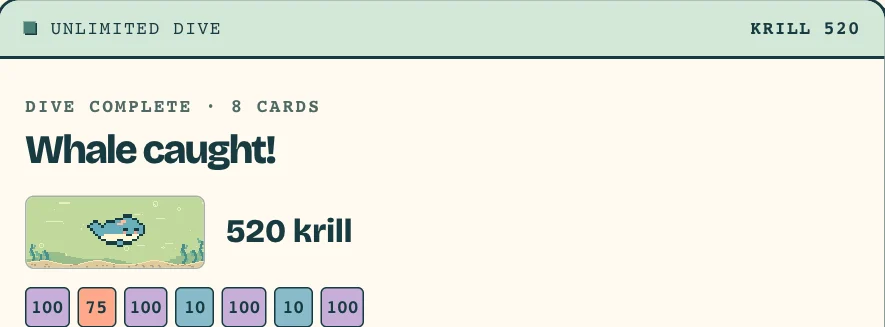
Each accepted answer has one of five values on its card: 10, 25, 50, 75 or 100 krill. The values are set in the deck. Another player entering the same answer to the same card gets the same award. You can use an accepted alternative spelling without changing that award. The checker ignores accents, and some local names and common abbreviations have their own entries pointing to the same place. A whole sentence or a pair of possible answers is harder to match than one clean place name.
Length matters when comparing Unlimited totals. A player who collects 100 krill from three tough questions has done something different from one who collects 100 across ten. If you challenge a friend to Geography Krillion Unlimited over dinner, agree on a stopping point first. Five cards each makes a quick contest. The questions will still be shuffled separately, but neither person gets an extra handful of cards to catch up. For identical questions in identical order, play today's Geography Krillion on the same UTC date.
The catch thresholds give a long session a natural stopping point. A Shrimp takes 30 krill, a Crab takes 80 and a Pufferfish takes 160. At 250 you reach Octopus, and 340 earns Whale. Imagine reaching 150 with one minute left before your train arrives. You can finish there and keep the Crab, or try one more card. Even an accepted 10-point answer is enough to move that particular score to Pufferfish.
Finishing, sharing and starting again
Finish dive is available on the recap after a card. If you want to stop while a question is open, you can submit an answer or skip it to reach that screen. The results page counts every card in your run. Once the session gets longer than seven, the recent-card review shows the latest seven. Earlier points still contribute to your total. That explains how a long run can have a larger score than the visible row of recent answers seems to allow.
Choose Share result to open the scorecard. The image is a convenient way to compare the length, catch and points of two sessions without giving away place names. If you want to attach it to a message, use the download option and select the image in your messaging app. If you would like another shuffle, New unlimited dive returns to the start panel. You can read the page or go back to the daily game there. The next timer begins when you choose Start unlimited dive.
You can also spread a run over more than one visit when your browser allows local storage. Return in the same browser on the same device. A private session or cleared site data can remove the saved run. Geography Krillion Unlimited keeps its own score, so you can leave for a Sports Krillion round and return to the same geography total. To find both games again, open the Krillions directory. For a particular day's geography questions, choose the date in the replay archive.
Unlimited geography questions
How often can I play Geography Krillion Unlimited?
As often as you like. Finish your current dive, choose New unlimited dive, then start a fresh deck from the welcome panel. You can play free online with no sign-up and no download.
Is there a seven-card limit in practice?
You decide when to finish. A run can be shorter or longer than seven cards. The result keeps the full total and shows up to seven recent card scores.
Does practice change my daily catch?
Your daily round keeps its own seven answers. You can switch back to it using the daily challenge link on the Unlimited start panel.


